Many students compare themselves to others during truck driving practice and begin to feel frustrated when progress does not match expectations. Seeing classmates advance faster can create unnecessary pressure and self-doubt, even when learning is happening at a healthy pace.
Needing extra practice often leads students to question their ability, but learning speeds naturally vary based on confidence levels, coordination, mental readiness, and prior driving habits. No two learners develop skills in exactly the same way.
This guide explains why extra practice is common, why it does not signal failure, and how consistent repetition helps drivers improve safety, control, and long-term confidence behind the wheel.
Key Takeaways
- Needing extra truck driving practice is normal and common
- Learning speed differs from student to student
- Confidence can rise and fall during training
- Extra practice improves safety, control, and awareness
- Continued practice leads to stronger long-term driving confidence
“Extra truck driving practice is not a setback. It’s often the stage where real skill and confidence begin to develop.”
Reasons Students Need Extra Truck Driving Practice
Many students need extra truck driving practice simply because learning pace differs from person to person. Some individuals adapt quickly to vehicle size, spatial awareness, and control, while others require more repetition to feel comfortable.
Needing additional practice does not indicate poor driving ability. In many cases, instructors recommend extra sessions to help reinforce safety habits, build consistency, and reduce hesitation. These recommendations are meant to support long-term success, not delay progress.
Extra truck driving practice allows students to slow down, correct small mistakes early, and develop smoother control. This approach leads to safer driving behavior and stronger decision-making over time.
Common Challenges During Truck Driving Practice
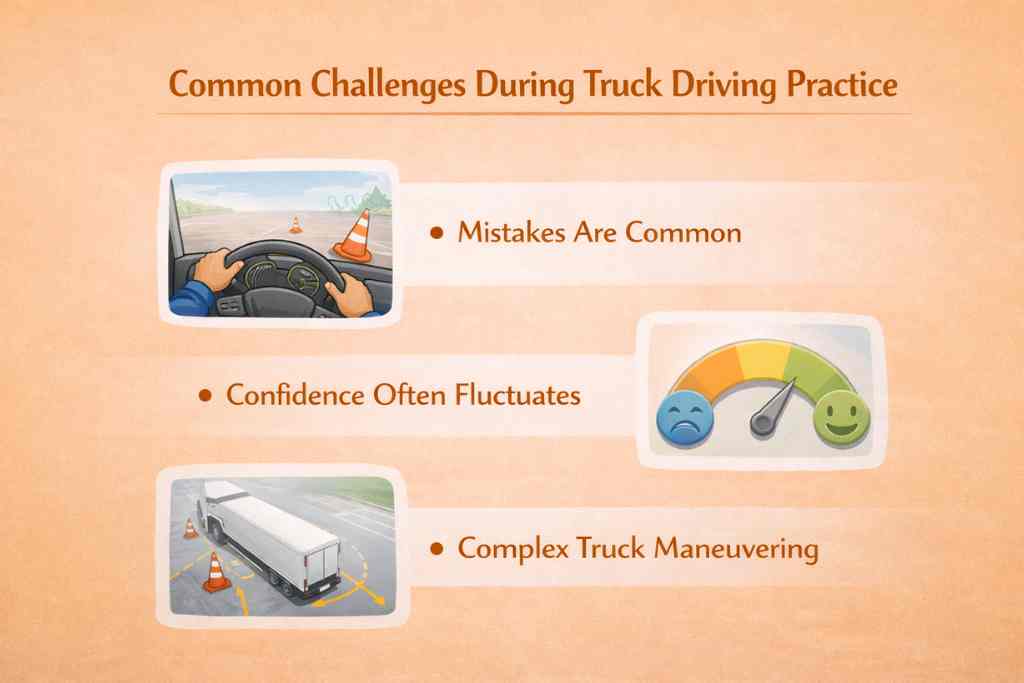
Truck driving practice introduces challenges that take time to overcome. Skills such as vehicle alignment, mirror usage, lane positioning, and coordination between steering and braking often require extended repetition.
Mistakes during practice are extremely common and shared by many learners. Confidence frequently rises one day and drops the next, especially when students feel nervous or overthink their actions.
Comparing progress with others can make these challenges feel worse. Each student starts with different experience levels, and progress is rarely linear.
How Previous Driving Habits Can Slow Progress
Many students enter truck driving practice with habits developed from years of car driving. These habits, while useful in smaller vehicles, can interfere with truck control.
Adjusting to larger blind spots, wider turns, longer stopping distances, and tight maneuvering areas takes time. Traffic situations that once felt simple may feel overwhelming at first.
Breaking old habits requires repetition, patience, and conscious awareness. With continued practice, these adjustments become natural.
Why Extra Practice Improves Safety and Real-World Readiness
Extra practice is not only about passing tests. It plays a key role in building safety-focused driving habits that carry into real-world situations.
Repeated practice strengthens muscle memory, reduces reaction time, and helps drivers stay calm under pressure. As familiarity grows, stress decreases and control improves.
Truck driving practice prepares students for unpredictable traffic conditions, not just controlled training environments.
How Confidence Builds With Continued Truck Driving Practice
Confidence during truck driving practice does not grow in a straight line. Many students feel confident one day and uncertain the next, which is a normal part of learning.
Over time, continued practice creates stability. Movements become smoother, decisions feel clearer, and hesitation decreases. Most students begin feeling steady confidence after repeated exposure to real driving scenarios.
Consistent truck driving practice leads to calmer driving and stronger self-trust behind the wheel.
FAQs
What is the hardest part of truck driving practice for new students?
Vehicle control, spatial awareness, and decision-making under pressure usually take the longest to develop.
What skills usually take the longest to improve during truck driving practice?
Mirror usage, lane positioning, turning judgment, and coordination between steering and braking often require extended practice.
Does needing extra practice mean a student is falling behind?
No. Needing extra practice is a normal part of skill development and often leads to stronger long-term performance.
Why do confidence levels change during training?
Confidence fluctuates as students face new challenges, correct mistakes, and adapt to different driving conditions.
How does consistent practice improve driving ability over time?
Repetition builds muscle memory, reduces stress, and improves decision-making in real traffic situations.
When do most students start feeling confident behind the wheel?
Confidence typically becomes more stable after consistent practice and repeated exposure to real driving scenarios.
Final Thoughts
Extra truck driving practice is a normal part of learning, not a sign of failure. Skill, confidence, and control develop gradually through repetition and patience.
Comparing progress with others often creates unnecessary pressure. Every driver improves at their own pace, and consistent practice leads to safer, more confident driving.
Students who stay patient, trust the learning process, and focus on steady improvement often see the strongest long-term results.